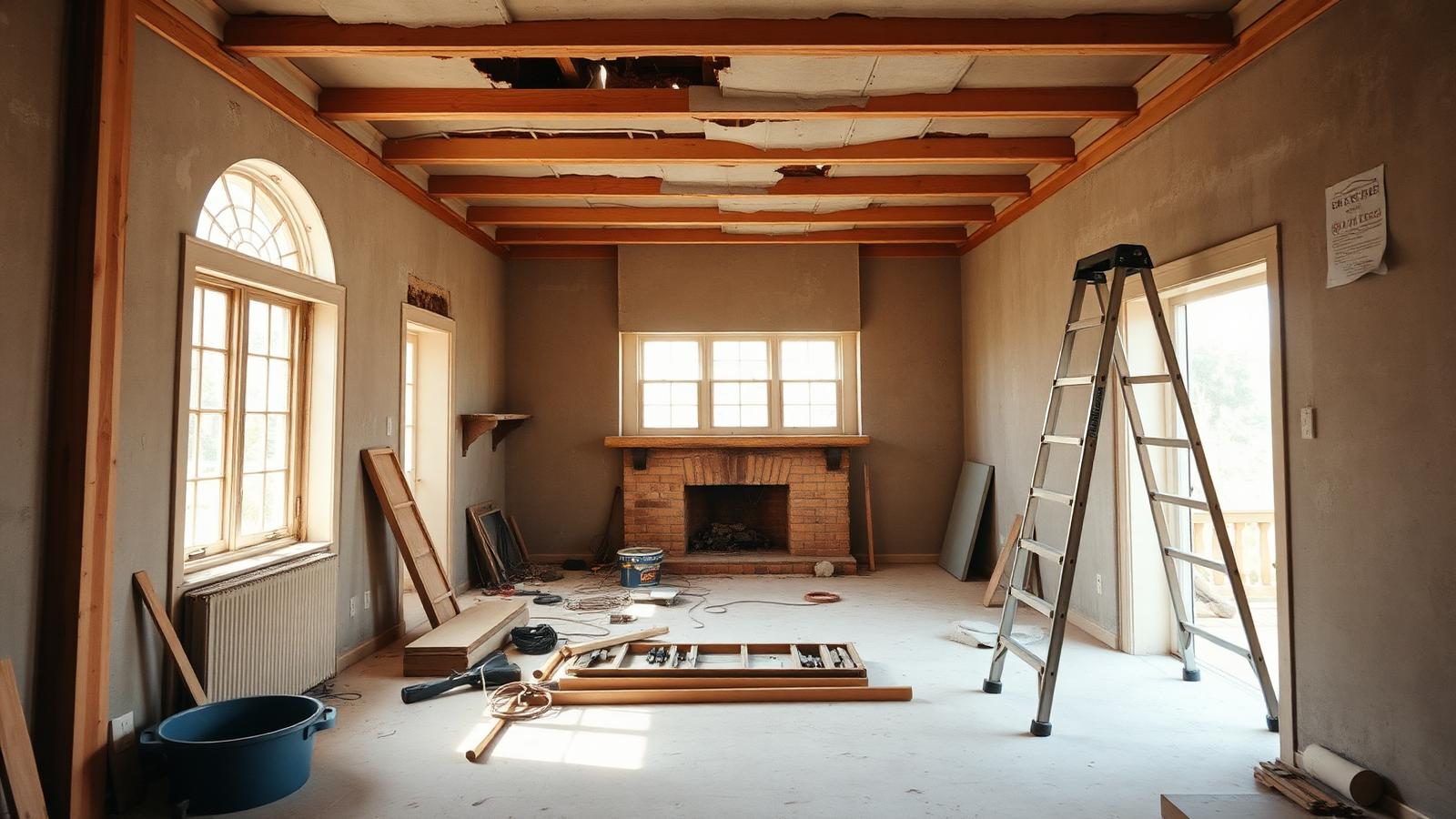
FHA 203(k) Renovation Loan: Buy and Rehab in One Loan
Buy a fixer-upper and roll renovation costs into one mortgage
Short answer: the 203(k) finances the purchase plus the renovation in one FHA mortgage at 3.5% down, with Limited covering up to $75,000 of non-structural work and Standard handling structural projects with a HUD consultant.
The FHA 203(k) loan lets you finance the purchase price and the cost of renovating a home in a single mortgage. There are two versions: the Limited 203(k) for repairs and improvements up to $75,000 with no structural work, and the Standard 203(k) for larger projects with no maximum repair cap (subject to FHA loan limits).
Talk to us about FHA 203(k)
Send your details and a licensed loan officer reviews your scenario. Florida and Colorado only.
1
Your info
2
Loan details
Quick answer
Can you finance repairs into an FHA loan with a 203(k)?
The FHA 203(k) rolls the purchase price and the cost of repairs into one FHA mortgage, underwritten on the after-improved value. The Limited 203(k) covers non-structural work up to $75,000, while the Standard 203(k) has no set repair ceiling below the county FHA limit and requires a HUD-approved 203(k) consultant. Down payment and MIP follow normal FHA rules.
What this means for your mortgage
If the home you want needs work you cannot pay for in cash, the 203(k) funds the repairs inside the same mortgage instead of a separate loan.
Reviewed by the licensed mortgage team at Simply Approved Mortgages · Last verified August 23, 2026 against HUD Handbook 4000.1
Purchase and renovation financed in a single FHA mortgage
Limited 203(k) covers non-structural repairs up to $75,000
Standard 203(k) allows structural work and requires a HUD-approved consultant
Loan is sized on the value of the home after the work is finished
Repair funds are held in escrow and released as work is completed
Same 3.5% down payment and mortgage insurance rules as other FHA loans
FHA Loan Rates for FHA 203(k)
Everything on this page about FHA 203(k) comes back to one question: what does the loan actually price at? FHA rate sheets price each scenario individually, so credit profile, loan amount, loan-to-value, units, term and lock length change the result. Enter your own numbers below to see live wholesale FHA options — note rate, provider APR, points or lender credit and the monthly payment — instead of a headline rate.
Snapshot pricing unavailable
No current pricing snapshot — we never show sample rate figures.
Sample scenario: Florida primary residence, 30-year fixed FHA. Pricing is refreshed once every business day and can change between refreshes.
Loading the most recent FHA pricing snapshot…
Snapshot pricing is an example for the sample scenario described above. It is not a quote, an application, a pre-approval, a rate lock, an offer of credit or a commitment to lend, and it is not personalized to you.
APR is supplied by our pricing provider for the exact scenario priced. Other lender or third-party charges listed separately may not be reflected, and the final APR can change. Your final mortgage disclosures control.
A lender credit reduces eligible closing costs only. It cannot exceed those costs and is never cash back to the borrower.
Get my own FHA pricing
The three cards above are examples from the latest daily snapshot. Enter your own purchase price, down payment, credit score and location to see every eligible FHA option for your scenario, priced right now.
What is an FHA 203(k) loan?
The FHA 203(k) renovation loan finances a home purchase and the cost of rehabbing it in a single mortgage, with the same 3.5% minimum down payment as a standard FHA loan. Instead of qualifying on what the house is worth today, you qualify on what it will be worth after the approved scope of work is complete.
There are two flavors. The Limited 203(k) handles cosmetic and non-structural work up to $75,000 — kitchens, baths, roofs, HVAC, flooring, paint, appliances. The Standard 203(k) starts at $5,000 in repairs, allows structural work, additions, and full gut rehabs, and requires a HUD-approved 203(k) Consultant to write the work order and inspect draws.
Renovation funds are held in escrow after closing and released to your contractors in draws as work passes inspection. Work has to start within 30 days of closing and finish inside the timeline in your rehab agreement, so contractor selection is the single biggest predictor of a smooth 203(k).
FHA 203(k) key features and benefits
Combines purchase + renovation in one loan
3.5% down on the total project cost
Limited 203(k): up to $75,000 in repairs, non-structural
Standard 203(k): $5,000 minimum, structural work allowed
Funds held in escrow and released as work is completed
Can be used for refinance + rehab on an existing home
Is an FHA 203(k) the right choice for you?
Choose FHA 203(k) if…
The home you want needs repairs a standard FHA appraisal would flag
You want to fund kitchen, bath, roof, or HVAC work without a separate loan
You are buying a HUD home, foreclosure, or dated property below market
You would rather have one closing and one payment than a purchase plus a rehab loan
Look at another option if…
The home is already move-in ready — a 203(b) closes faster and cheaper
You need to close in under 30 days
You want to do the work yourself without licensed contractors
The project is mostly luxury additions like a pool or outdoor kitchen
A 203(k) needs everything a standard FHA loan needs plus a documented renovation plan. Gather the contractor package early — it drives your closing date.
Identity & residency
Government-issued photo ID for every borrower
Social Security number or ITIN documentation
Two-year residence history with addresses
Income
Last 30 days of pay stubs
W-2s for the past two years
Two years of federal tax returns (all schedules) if self-employed, commissioned, or 25%+ owner
Year-to-date profit & loss for self-employed borrowers
Award letters for Social Security, pension, disability, or child support income
Assets
Two months of full bank statements (all pages)
Most recent retirement or brokerage statement if using those funds
Gift letter plus donor's proof of funds and the transfer trail
Credit & property
Authorization for a tri-merge credit report
Written explanation letters for late payments, collections, or credit inquiries
Bankruptcy discharge or foreclosure documents if applicable
Fully executed purchase contract and all addenda
Homeowners insurance quote and, in flood zones, a flood insurance quote
Renovation package
Detailed line-item contractor bid for every trade
Contractor license, insurance certificate, and W-9
Homeowner/contractor agreement with a start and completion schedule
HUD-approved 203(k) Consultant work write-up (Standard 203(k))
Plans, specs, and permits for structural work
Self-help agreement if any work is borrower-performed
Who an FHA 203(k) loan is best for
Buyers purchasing a fixer-upper, distressed property, or HUD home, and homeowners doing a major remodel.
FHA 203(k) requirements in 2026
All FHA 203(b) requirements apply
Detailed contractor bids and work write-up
HUD-approved 203(k) Consultant required for Standard 203(k)
Repairs must begin within 30 days of closing and complete within 6 months
Property must become safe, livable, and code-compliant
FHA 203(k) pros and cons
What we like
Finance repairs at the same low FHA rate
Buy properties most conventional lenders won't touch
Build instant equity with strategic improvements
One closing, one loan, one payment
Trade-offs to know
More paperwork than a 203(b)
Longer closing timelines (45–60 days)
Requires licensed contractors with bids
Standard 203(k) requires a HUD consultant
How the FHA 203(k) process works
1
Choose Limited or Standard
Under $75,000 with no structural work points to Limited. Structural changes, additions, or a larger budget mean Standard with a consultant.
2
Get contractor bids
Licensed, insured contractors produce a detailed line-item bid. Bids drive the escrow amount, so vague estimates stall the file.
3
After-improved appraisal
The appraiser values the home as if the work is already done, using the plans and specs. That value drives your maximum loan.
4
Close and fund escrow
You close on the purchase; renovation money goes into a rehab escrow account rather than to the seller.
5
Draws and inspections
Contractors are paid in stages as inspections confirm completion. A 10% holdback is standard until final sign-off.
6
Final inspection and payoff of contingency
Leftover contingency reserve is applied to your principal or funds additional approved work.
Sample 203(k) structure on a $300,000 fixer-upper
Illustrative only. Loan amounts are capped by the after-improved value and your county FHA loan limit.
Purchase price
$300,000
Renovation budget
$60,000
Contingency reserve (10–20%)
$9,000
Total project cost
$369,000
Down payment (3.5%)
$12,915
Calculated on total project cost
Base loan amount
$356,085
Upfront MIP (1.75%)
$6,231
Financed
How an FHA 203(k) loan helps real borrowers
Illustrative examples built from published FHA rules to show how the math works. They are not customer stories, rate quotes, or guarantees — your numbers depend on credit, county limits, and pricing at the time you lock.
Dated listing nobody else will finance
The situation: A $260,000 house is priced below the neighborhood because the kitchen is gutted and the roof is at the end of its life — conditions that fail a standard appraisal.
How the loan helps: A 203(k) rolls the purchase price and the renovation budget into one FHA loan based on the after-improved value, so the buyer does not need a separate construction loan, cash for repairs, or a HELOC after closing.
Purchase price
$260,000
Renovation budget
$55,000
After-improved value
$345,000
3.5% down (on total)
$11,025
The outcome: The buyer finances the repairs at mortgage rates instead of credit-card or personal-loan rates, and starts with instant equity from the improved value.
Figures are illustrations based on the values you entered — not an offer, rate lock, or commitment to lend. Emailing your scenario sends it to a licensed loan officer in Florida or Colorado.
203(k) buyers can still use down payment assistance. The FHA DPA Program second lien and most state and county programs apply to the 3.5% required investment on the total acquisition cost, not just the purchase price.
What is the difference between Limited and Standard 203(k)?
Limited 203(k) covers up to $75,000 of non-structural work with no HUD consultant required. Standard 203(k) has a $5,000 minimum, permits structural work and additions, and requires a HUD-approved consultant.
What credit score do I need for a 203(k)?
The same 580 FICO floor for 3.5% down applies, but renovation lenders commonly overlay 620–640 because of the added project risk.
Can I do the renovation work myself on a 203(k)?
Self-help is technically allowed but rarely approved. Lenders almost always require licensed, insured contractors with a documented bid and schedule.
How long does a 203(k) take to close?
Plan on 45 to 60 days. The bid, work write-up, and after-improved appraisal add time compared with a standard 203(b).
FHA 203(k) frequently asked questions
What is the difference between Limited and Standard 203(k)?
Limited 203(k) covers up to $75,000 of non-structural work with no HUD consultant required. Standard 203(k) has a $5,000 minimum, permits structural work and additions, and requires a HUD-approved consultant.
What credit score do I need for a 203(k)?
The same 580 FICO floor for 3.5% down applies, but renovation lenders commonly overlay 620–640 because of the added project risk.
Can I do the renovation work myself on a 203(k)?
Self-help is technically allowed but rarely approved. Lenders almost always require licensed, insured contractors with a documented bid and schedule.
How long does a 203(k) take to close?
Plan on 45 to 60 days. The bid, work write-up, and after-improved appraisal add time compared with a standard 203(b).
Can I refinance with a 203(k)?
Yes. A rate-and-term refinance can include rehab funds for a home you already own, subject to the after-improved value and county loan limit.
Are luxury items eligible?
No. Pools, outdoor kitchens, and similar amenities are ineligible, though repairing an existing pool is generally allowed.
What happens to unused renovation money?
Leftover contingency and unspent escrow are applied as a principal reduction to your loan.
How are contractors paid?
From an escrow account in inspected draws as work is completed, with a holdback until final completion.
Can I live in the home during renovation?
Often yes on Limited projects. Standard projects that leave the home uninhabitable have separate rules, including financing payments during that period.
Does the appraisal use the after-repair value?
Yes. The appraiser values the property as-completed based on the plans and specifications.
What work is not allowed?
Luxury improvements are excluded, and Limited 203(k) also excludes structural work. Health, safety, and functional improvements are the core of the program.
Can a 203(k) be used to refinance?
Yes. An existing owner can refinance and finance renovations in the same transaction.
How long does the work have to take?
HUD sets completion deadlines from closing that vary by program, and the lender monitors progress.
Are contractor bids required upfront?
Yes. Detailed written bids from licensed, insured contractors are part of the underwriting package.
Simply Approved Mortgages is not affiliated with or endorsed by HUD, FHA, or any government agency.
Included with your FHA estimate
Get your FHA Pre-Approval Summary.
Complete the short form and we send back a full FHA breakdown: your county loan limit, the minimum FHA down payment, financed upfront MIP, monthly mortgage insurance, and an estimated payment — plus whether down payment assistance can cover your cash to close.
Maximum FHA loan amount for your county
Minimum FHA down payment and cash-to-close estimate
Upfront and annual MIP included
Estimated monthly payment with taxes and insurance
Takes about 3 minutes · No obligation · Summary emailed and shown on screen
Illustration only, generated from the information you enter. Not a Loan Estimate, pre-qualification, commitment to lend, or approval. Subject to appraisal, credit and income review, FHA guidelines, and final lender approval. Equal Housing Opportunity.
FHA Estimate Summary
Purchase price
$385,000
Down payment (3.5%)
$13,475
Base loan amount
$371,525
Financed UFMIP (1.75%)
$6,502
Est. monthly payment
Shown in your summary
Sample figures for illustration only — not a quote, rate lock, offer of credit or commitment to lend. Simply Approved Mortgages · NMLS #2620881 · Equal Housing Opportunity
Income documentation
Self-employed vs. W-2 employed: what it means for your FHA loan
The program you choose does not change how your income is documented — how you are paid does. FHA does not apply a different credit score, down payment or county limit to self-employed borrowers — it applies a different documentation standard.
FHA documentation differences between W-2 employed and self-employed borrowers
Item
W-2 employed
Self-employed
History required
Two-year employment history, with gaps explained. A job change inside the same field is usually fine.
Generally two years of self-employment. A shorter history can sometimes be considered when there is documented prior experience in the same line of work.
How income is calculated
Base pay from pay stubs and W-2s. Bonus, overtime and commission generally need a two-year history to be averaged in.
Net income from tax returns, averaged and adjusted for allowable add-backs such as depreciation. Write-offs that reduce taxable income also reduce qualifying income.
Documents that open the file
30 days of pay stubs, two years of W-2s, and a verification of employment.
Two years of personal and business returns, year-to-date P&L and balance sheet, and evidence the business is still operating.
Verification at closing
The employer is re-verified shortly before closing; do not change jobs mid-process without telling your loan officer.
Continued existence of the business is re-verified close to closing, typically through a third-party or licensing check.
Most common delay
Unexplained gaps, a new job with variable pay, or a VOE the employer never returns.
A declining year over year, or a large deduction that removes the very income needed to qualify.
What we suggest
Get the VOE moving on day one — it is the item most often outstanding at the end.
Have your accountant produce the year-to-date P&L before you shop, so qualifying income is known before you write an offer.
If you are W-2 employed
Pay stubs covering the most recent 30 days
W-2 forms for the last two years
A verification of employment; HUD Handbook 4000.1 Update 18 tightened the written and electronic VOE rules, so expect the employer record to be verified directly
Documentation of bonus, overtime or commission income if you want it counted
If you are self-employed
Two years of personal federal tax returns, all schedules
Two years of business returns for a partnership, S-corp or C-corp, plus K-1s
A year-to-date profit and loss statement and balance sheet
Business license, CPA letter or equivalent evidence the business is active
General FHA documentation guidance per HUD Handbook 4000.1, including Update 18 changes to written and electronic verification of employment. Requirements vary by borrower, property, lender and program, and all loans are subject to lender underwriting and approval. Sources: HUD Handbook 4000.1
Run the numbers for your county
FHA payment, affordability, closing cost and refinance calculators for the United States
Prefilled with the 2026 HUD reference median of $415,000 for the United States, a 0.90% effective property tax rate and a directional $2,300 annual homeowners premium. Change any input — the interest rate is your own assumption, not an offer.
Figures are illustrations based on the values you entered — not an offer, rate lock, or commitment to lend. Emailing your scenario sends it to a licensed loan officer in Florida or Colorado.
Estimates for general educational purposes only. Interest rates shown are assumptions you enter, not quoted rates, and nothing here is a rate lock, APR, payment quote, pre-approval, offer or commitment to lend. Results exclude HOA dues, flood or wind policies, mortgage insurance changes, points and lender-specific fees. FHA upfront MIP of 1.75% and annual MIP of 0.55% follow HUD Mortgagee Letter 2023-05 for a 30-year term at 3.5% down. Property tax and insurance inputs are directional state references, not a parcel-level bill. Eligibility, terms, conditions and availability vary by borrower, property, lender, loan program and state. All loans are subject to lender underwriting and approval. Equal Housing Opportunity. Sources: HUD Mortgagee Letter 2023-05 (MIP) · HUD Mortgagee Letter 2025-23 (2026 loan limits) · U.S. Census Bureau ACS · NAIC homeowners insurance · CFPB Closing Disclosure
Taxes, insurance and local expenses
What owning actually costs in the United States
Mortgage pricing moves the payment a little. Property tax and insurance move it a lot, and they are entirely local. These figures are built from the 2026 HUD county dataset for the United States and national tax and settlement conventions, reviewed August 23, 2026.
Estimated ownership costs in the United States on a $415,000 home
Cost
Estimate
How it works here
Property tax
$311 / mo
About 0.90% effective on $415,000 — roughly $3,735 a year. Millage is set locally, so verify the parcel's actual bill.
Homeowners insurance
$192 / mo
Directional $2,300 a year for a single-family owner policy in the U.S.. Wind, hail and flood may be separate policies.
FHA annual mortgage insurance
$184 / mo
0.55% of the $400,475 base loan at 3.5% down, 30-year term, per HUD Mortgagee Letter 2023-05.
FHA upfront MIP
$7,008
1.75% of the base loan, normally financed into the $407,483 total loan amount rather than paid in cash.
State transfer / documentary tax
Varies
Transfer, deed, recordation and mortgage taxes are set state by state — several states charge none at all.
Settlement convention
Title/escrow state
A title or escrow company customarily conducts the closing and issues the policy.
The expense buyers here miss most
Property tax and homeowners insurance vary far more between two states than mortgage pricing does — always re-price the escrow on the exact county before you write an offer.
How this affects the FHA file
Taxes and insurance are part of the qualifying payment, so a $503 escrow in your county consumes debt-to-income capacity before a single dollar of principal and interest is counted. Underwriting uses the post-closing figures, not the seller's current bill.
Estimates for general education only — not a quote, rate, APR, pre-approval, offer or commitment to lend. Property tax rates are effective rates derived from U.S. Census Bureau ACS data; actual millage is set by county, city, school and special districts. Insurance figures are directional annual premiums, not quotes. Transfer, deed, recordation and mortgage taxes summarise state-level statutes; counties and municipalities frequently add their own. Eligibility, terms, conditions and availability vary by borrower, property, lender, loan program and state, and all loans are subject to lender underwriting and approval. Sources: U.S. Census Bureau — ACS property tax data · NAIC Homeowners Insurance Report · CFPB — understanding closing costs
Simply Approved Mortgages Expert Insight
Renovation commentary · Last reviewed August 23, 2026
Choose Limited or Standard by scope, not by preference
Limited 203(k) suits cosmetic and non-structural work under the program cap with no consultant required. Structural work, additions, or larger budgets belong on Standard with a HUD consultant. Scoping this correctly at the start prevents a mid-process restart.
Our recommendation
Get the contractor scope in writing before choosing Limited or Standard.
Ask SAM anything about FHA loans in the United States
SAM is the Simply Approved Mortgages AI assistant, grounded in HUD Handbook 4000.1 and the 2026 HUD county limit file. It answers general FHA questions instantly. A licensed loan officer reviews every scenario before any terms are confirmed.
Hi — I'm SAM. Ask me about FHA loan limits, credit, mortgage insurance, down payment assistance or what an underwriter will need from you. General education only: I don't quote rates, and nothing I say is an offer or commitment to lend.
Ask Simply AI provides general educational information about FHA loan programs. It is an automated assistant, may be incomplete or out of date, and does not provide legal, tax or financial advice. Nothing it produces is a rate quote, APR, pre-approval, offer or commitment to lend. Simply Approved Mortgages LLC (NMLS #2620881) arranges residential mortgage loans in Florida and Colorado. Eligibility, terms, conditions and availability vary by borrower, property, lender, loan program and state, and all loans are subject to lender underwriting and approval. Equal Housing Opportunity.
Where to go next
Continue with the FHA topic that matches where you are, or talk to a licensed loan officer about your own numbers.
Short on cash to close? Ask about the FHA DPA, offered through Simply Approved Mortgages: 2.5%, 3.5%, or 5% of your loan amount toward your down payment and closing costs, structured as a 10-year repayable second lien at your first-mortgage rate + 2%. FICO 580+, primary residence only — it's an option on every loan program on this site.
How it works
Three tiers. Real money toward your home.
2.5% / 3.5% / 5% of the lesser of purchase price or appraised value
Pairs with FHA, Conventional, VA, and USDA first mortgages
10-year repayable second lien — no silent forgivable strings
Not available in: New York, Washington, U.S. Virgin Islands, Guam, Northern Mariana Islands, and American Samoa. All loans subject to underwriting approval and program guidelines.
Amount calculator & eligibility checker
See how much assistance you may qualify for
Enter a purchase price, pick an assistance tier, and confirm property and residency. Results are illustrative — not a quote or commitment.
Simply Approved Mortgages DPA
DPA amount calculator & eligibility checker
Estimate 3.5% assistance on the lesser of price or appraisal, layered over a 30-year fixed FHA first mortgage.
Estimated DPA
$14,000
3.5% of $400,000
2nd-lien P&I
$174
10-yr · 8.500%
Amount calculator
Lesser of price or appraisal
$400,000
DPA at 3.5%
$14,000
2nd-lien term
10-year fixed, repayable
2nd-lien rate
8.500%
Monthly P&I
$174/mo
Illustrative only — not a quote, lock, offer, or commitment to lend. Binding figures appear only on your Loan Estimate and Closing Disclosure.
Eligibility checker
Documentable qualifying income?
Willing to complete homebuyer education before closing?
Property in NY, WA, USVI, Guam, MP, or AS?
Answer each question above to see your preliminary result.
Figures are illustrations based on the values you entered — not an offer, rate lock, or commitment to lend. Emailing your scenario sends it to a licensed loan officer in Florida or Colorado.
Preliminary self-check only — no credit pulled. Not a quote, lock, offer, or commitment to lend. Simply Approved Mortgages is not affiliated with HUD, FHA, VA, USDA, FHFA, or any government agency. Equal Housing Opportunity. NMLS# 2620881.
Our pricing philosophy
Transparency. Simplicity. Consumer Choice.
At Simply Approved Mortgages, we believe borrowers deserve clear information, professional guidance, and access to competitive mortgage solutions.
Our company is built around a straightforward philosophy: provide transparent mortgage guidance, maintain a consistent compensation structure on most transactions, and help borrowers make informed financing decisions based on their individual needs and goals.
For many mortgage transactions, Simply Approved Mortgages typically operates using a lender-paid compensation structure of approximately 1.50%. Actual compensation may vary based on lender requirements, loan program, state regulations, loan amount, and other transaction-specific factors.
We believe transparency helps consumers better understand the mortgage process and make informed decisions when comparing financing options.
Our promise
Mortgage financing should be understandable, transparent, and focused on helping consumers make informed decisions.
Our goal isn't to maximize compensation per transaction. Our goal is to build lifelong client relationships through transparency, service, and competitive mortgage solutions.
Why compensation transparency matters
Understanding all aspects of the financing process
Many borrowers spend significant time comparing interest rates, but may be less familiar with how mortgage companies and loan originators are compensated.
Compensation structures can vary among lenders, mortgage brokers, banks, credit unions, and other mortgage providers. Compensation is only one component of a mortgage transaction and should be evaluated alongside interest rates, APR, lender fees, discount points, closing costs, loan features, and overall loan suitability.
At Simply Approved Mortgages, we believe consumers benefit from understanding all aspects of the financing process before making a decision.
Interactive illustration
See how compensation scales by loan amount
Move the slider to compare a hypothetical 1.50% Simply Approved Mortgages compensation structure with a hypothetical 2.75% used by some other lending options. For educational purposes only.
$400,000
$50,000$2,000,000
Typical market comp at 2.75%$11,000
Simply Approved Mortgages at 1.50%$6,000
Potential closing cost difference
Hypothetical impact on lender compensation only
~$5,000
For illustration only. Figures are hypothetical and not a quote, offer, rate lock, or guarantee of savings. Lender compensation is one component of closing costs; actual loan terms, interest rates, fees, APR, and total costs vary by program, loan amount, credit qualifications, property, occupancy, state, and market conditions.
Illustrative compensation comparison
Comparing a hypothetical 1.50% to a hypothetical 2.75%
The example below compares a hypothetical 1.50% compensation structure used by Simply Approved Mortgages to a hypothetical 2.75% structure used by some other lending options, solely for educational purposes.
Loan Amount
Simply Approved Mortgages (1.50%)
Other lending options (2.75%)
Difference
$250,000
$3,750
$6,875
$3,125
$350,000
$5,250
$9,625
$4,375
$500,000
$7,500
$13,750
$6,250
$750,000
$11,250
$20,625
$9,375
$1,000,000
$15,000
$27,500
$12,500
These examples are illustrative only and are intended to demonstrate how different compensation percentages may produce different compensation amounts based on loan size.
These examples do not represent borrower fees, interest rates, APR, closing costs, loan terms, pricing, or savings, and should not be interpreted as a guarantee that any borrower will receive lower costs or better loan terms.
Our commitment to borrowers
Our goal is to provide
Professional mortgage guidance
Transparent communication throughout the loan process
Access to a broad range of mortgage programs
Competitive financing options based on borrower qualifications
A streamlined application and approval experience
Support for homebuyers, homeowners, and real estate investors
A team-focused approach
Support for every type of borrower
Whether you're purchasing a home, refinancing an existing mortgage, consolidating debt, or financing an investment property, our team is committed to helping you evaluate available options and make informed decisions.
Compare more than just the interest rate
When evaluating mortgage options, borrowers should consider the complete financing package
•Interest Rate
•Annual Percentage Rate (APR)
•Lender Fees
•Discount Points
•Closing Costs
•Loan Features and Flexibility
•Prepayment Terms
•Product Eligibility Requirements
•Customer Service and Support
The most appropriate mortgage solution depends on each borrower's individual financial circumstances, objectives, qualifications, and preferences.
Important Disclosure: Simply Approved Mortgages LLC typically utilizes a lender-paid compensation structure of approximately 1.50% on many mortgage transactions; however, compensation may vary based on lender requirements, loan program, state law, loan amount, borrower qualifications, and other transaction-specific factors. Compensation is only one component of mortgage pricing and does not, by itself, determine interest rates, APR, lender fees, closing costs, loan terms, or overall borrower costs. The information provided on this page is for general educational and informational purposes only and should not be construed as mortgage advice, a commitment to lend, an offer to extend credit, a rate quote, a loan approval, or a guarantee of savings. All mortgage loans are subject to credit approval, underwriting requirements, property approval, and program eligibility guidelines. Borrowers should carefully review all disclosures, including the Loan Estimate and Closing Disclosure, before proceeding with any mortgage transaction. Simply Approved Mortgages LLC • NMLS #2620881 • Equal Housing Opportunity.
Ready when you are
Get pre-qualified in minutes — no obligation.
Talk to a licensed Simply Approved Mortgages loan officer. We'll review your goals, walk through FHA, Conventional, VA, USDA, and DPA options, and give you straight answers — same day.
The FHA's minimum is 500, but lender overlays push the real-world minimum to 580 or 620. Here's what scores actually get approved.
February 19, 2026 · 7 min read
FHA Homebuyer Newsletter
FHA rate moves, county loan limits, and guideline changes — in your inbox.
Twice-a-month updates for buyers and homeowners: rate movement, FHA guideline changes, new down payment assistance programs, and the deals we're closing. No spam, unsubscribe anytime.
✓Weekly FHA rate snapshot
✓County loan limit updates
✓First-time buyer playbooks
✓DPA & program change alerts
FHA Newsletter
FHA rate updates, market trends, and program changes. No spam.
By subscribing, you consent to receive FHA rate and program update emails from Simply Approved Mortgages LLC. This is not an application for credit and not an offer or commitment to lend. Unsubscribe any time. Read our Privacy Notice.